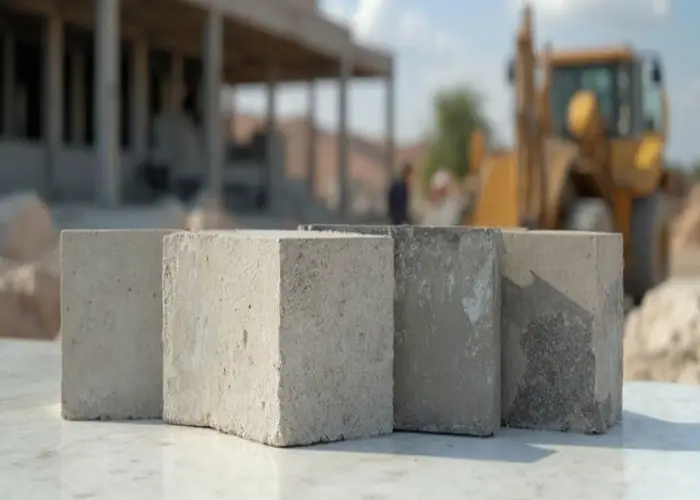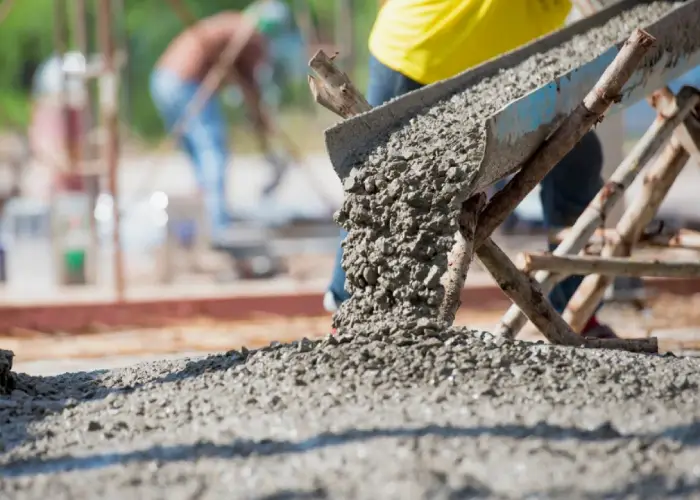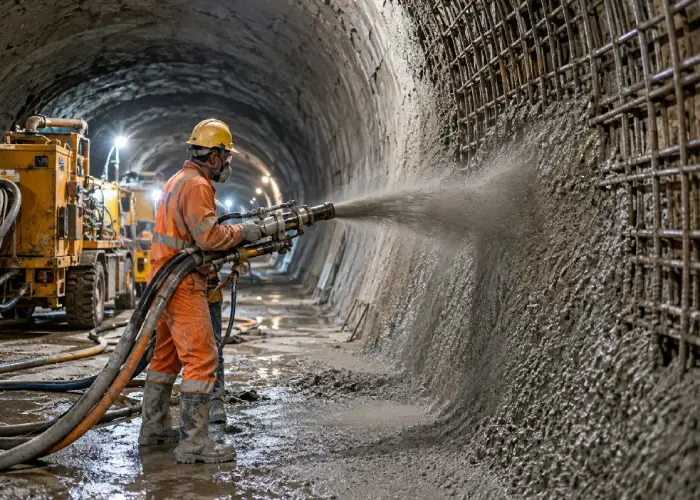
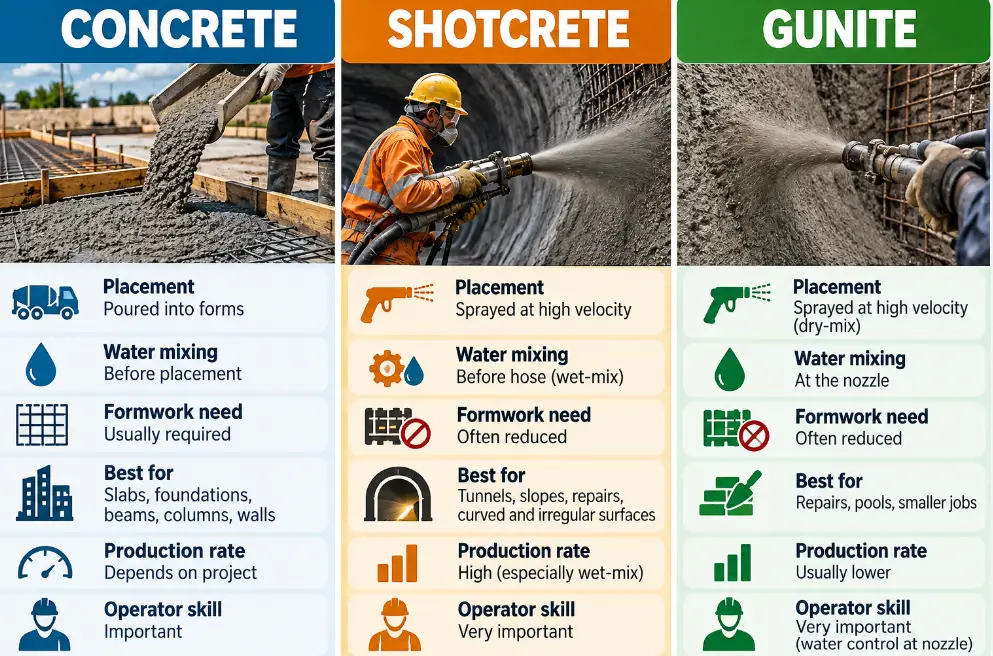
The main difference between shotcrete, concrete, and gunite is the way the material is placed. Traditional concrete is usually poured into forms. Shotcrete is concrete or mortar sprayed onto a surface at high velocity. Gunite is a dry-mix form of shotcrete where water is added at the nozzle.
So, when comparing shotcrete vs concrete vs gunite, there is no single option that is best for every project. Conventional concrete works well for slabs, foundations, beams, and other formed structures. Is shotcrete better than gunite? Shotcrete is often a better choice for tunnels, slopes, repairs, curved surfaces, and areas where formwork is difficult. Gunite is useful for repair work, smaller placements, pools, and projects that require frequent stops and starts. Stay with us to read more about concrete vs Shotcrete vs gunite.
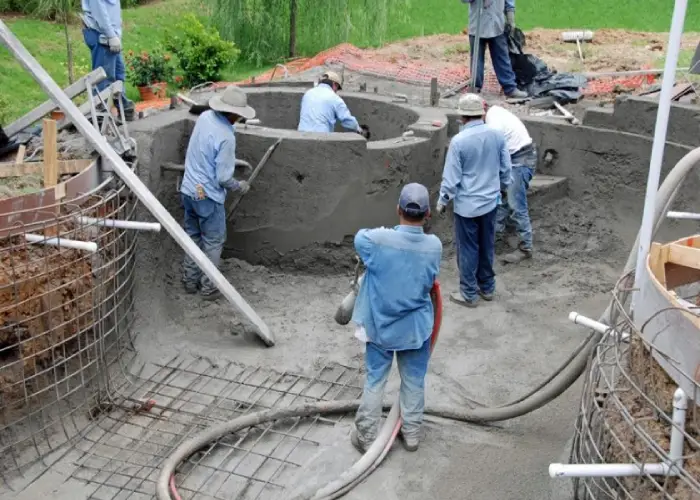
Shotcrete vs Concrete vs Gunite: Quick Look at Main Differences
Let us have a quick look at shotcrete vs concrete vs gunite:
| Feature | Concrete | Shotcrete | Gunite |
| Placement | Usually poured | Sprayed at high velocity | Sprayed at high velocity |
| Water addition | Before placement | Before pumping in wet-mix | At the nozzle |
| Formwork | Usually required | Often reduced | Often reduced |
| Best use | Slabs, foundations, structures | Tunnels, slopes, repairs | Repairs and smaller jobs |
| Production rate | Depends on project | High with wet-mix | Usually lower |
| Stop/start work | Possible | Less suitable with wet-mix | Very suitable |
| Operator skill | Important | Very important | Very important |
The final quality of all three methods depends on mix design, equipment, placement, operator experience, and curing.
What Is Concrete?
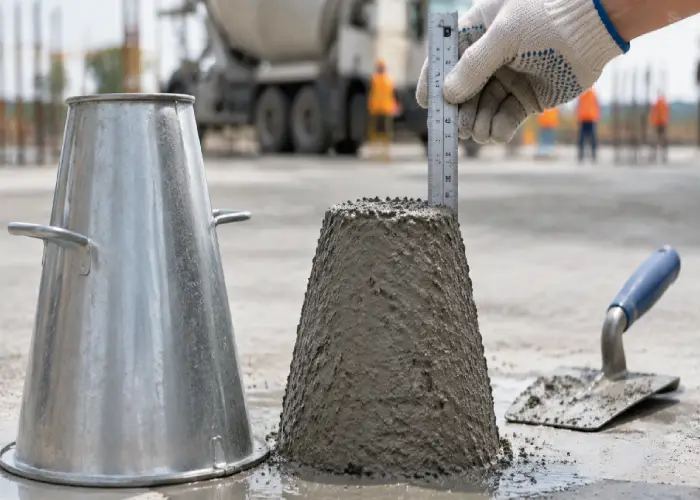
Concrete usually contains cement, water, aggregates, and sometimes admixtures. Workers normally pour fresh concrete into formwork and then compact, finish, and cure it. This method is common for:
- foundations
- slabs
- beams and columns
- walls
- bridges
- retaining structures
- tunnel linings
Conventional concrete is practical when workers have enough space for formwork and normal placement equipment.
Its main limitation is that complex shapes can require more formwork, labor, and preparation time.
What Is Shotcrete?
Shotcrete vs concrete vs gunite is concrete or mortar projected onto a surface at high velocity. The impact helps compact the material as it reaches the surface.
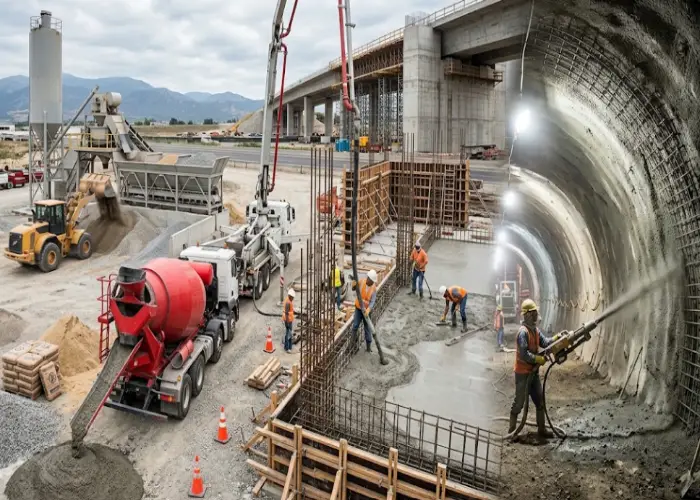
This method allows workers to apply concrete to vertical, overhead, curved, and irregular surfaces. In many projects, shotcrete also reduces the need for conventional formwork. There are two main shotcrete methods.
1. Wet-Mix Shotcrete
In wet-mix shotcrete, workers mix the water, cement, aggregates, and other materials before pumping the mixture through the hose. Compressed air is added at the nozzle to spray the material onto the surface.
Wet-mix shotcrete is usually more suitable for larger jobs because it can provide a higher production rate. It also creates less rebound than dry-mix systems.
2. Dry-Mix Shotcrete
In dry-mix shotcrete, the dry materials move through the hose first. Water is added at the nozzle. This gives the nozzle operator more control over water content, but it also makes operator skill very important.
Dry-mix shotcrete is often suitable for smaller repairs, lower-volume work, and projects where workers need to stop and restart frequently.
What Is Gunite?
Gunite is not a completely separate material from shotcrete. Gunite is the traditional name for the dry-mix shotcrete process. In this method, dry cementitious materials and aggregates travel through the hose, while water enters at the nozzle. Today, the term shotcrete covers both wet-mix and dry-mix methods. So, in simple terms:
Gunite = dry-mix shotcrete.
This point is important when comparing concrete vs shotcrete vs gunite.
Shotcrete vs Concrete: Which One Is Better?
The answer depends on the job. Concrete is often the better choice for large flat sections, foundations, slabs, and structural elements where formwork is already part of the construction plan.
Shotcrete is often more practical when the surface is difficult to reach or has an irregular shape. It is commonly used for:
- tunnel support
- slope stabilization
- retaining walls
- excavation support
- concrete repair
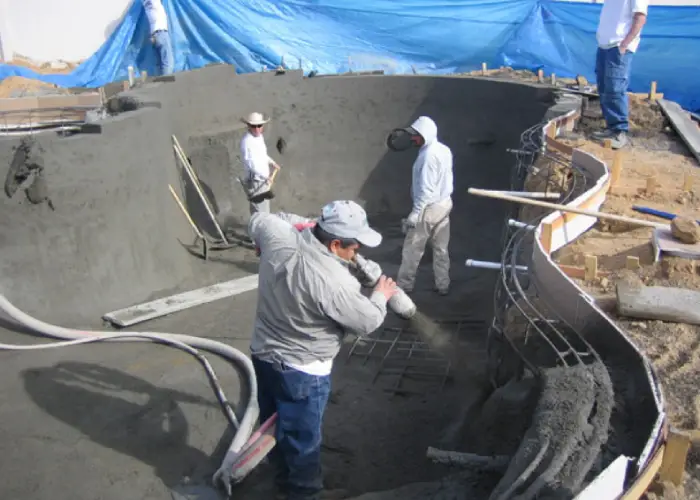
- pools
- tanks
- underground structures
One major advantage of shotcrete is that it can reduce formwork. It can also bond well to properly prepared surfaces and reach areas where normal concrete placement is difficult.
Is Shotcrete Better Than Gunite?
People often ask, Is shotcrete better than gunite? Technically, this is not the right comparison because gunite is a type of shotcrete. The real question is whether wet-mix or dry-mix shotcrete is better for the project.
Wet-mix shotcrete is usually better for high-volume work. It offers faster production and generally produces less rebound.
Gunite, or dry-mix shotcrete, can be better for smaller jobs and repair work. It also works well when crews need to stop and restart the spraying process several times.
The right method depends on:
- project size
- required output
- site access
- pumping distance
- equipment availability
- crew experience
Main Benefits of Shotcrete
Shotcrete has some main advantages:
- less formwork
- fast application
- good access to difficult areas
- easy application on vertical surfaces
- suitable for overhead work
- useful for curved and irregular shapes
- suitable for new construction and repair
- effective for tunnel and slope projects
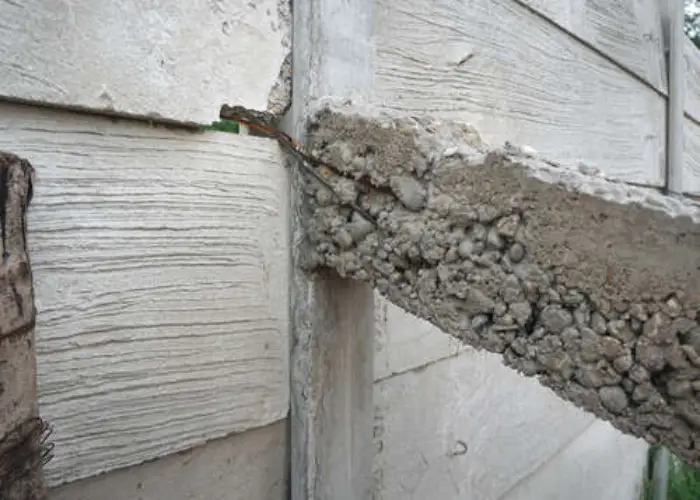
Do not forget that good equipment and an experienced nozzle operator are essential. Poor application can lead to excessive rebound, uneven thickness, voids, or weak areas.
Proper curing is also important because shotcrete still follows the same basic concrete principles after placement.
Tiran Tunnel Biston Shotcrete Equipment
Tiran Tunnel Biston provides equipment for shotcrete, mortar spraying, tunneling, and civil engineering projects. Choosing the right machine depends on the project conditions. Contractors should consider the required output, wet-mix or dry-mix process, aggregate size, pumping distance, material type, and working conditions before selecting a machine.
Tiran Tunnel Biston offers equipment for shotcrete and mortar applications, including piston-based systems and machines designed to spray and pump construction materials. Visit our website to choose the best products for your projects.
FAQs
- What is the main difference between shotcrete and concrete?
Concrete is normally poured into forms, while shotcrete is sprayed onto a surface at high velocity. The main difference is how you place it.
- Is gunite the same as shotcrete?
Gunite is a dry-mix form of shotcrete. Shotcrete is the wider term and includes both wet-mix and dry-mix processes.
- Is shotcrete stronger than concrete?
Not automatically. Strength depends on the mix design, materials, application quality, and curing. Properly applied shotcrete can provide strong and durable concrete.
- Is shotcrete better than gunite?
It depends on the job. Wet-mix shotcrete is often better for larger projects, while gunite can be more practical for smaller repairs and work that needs frequent stops.