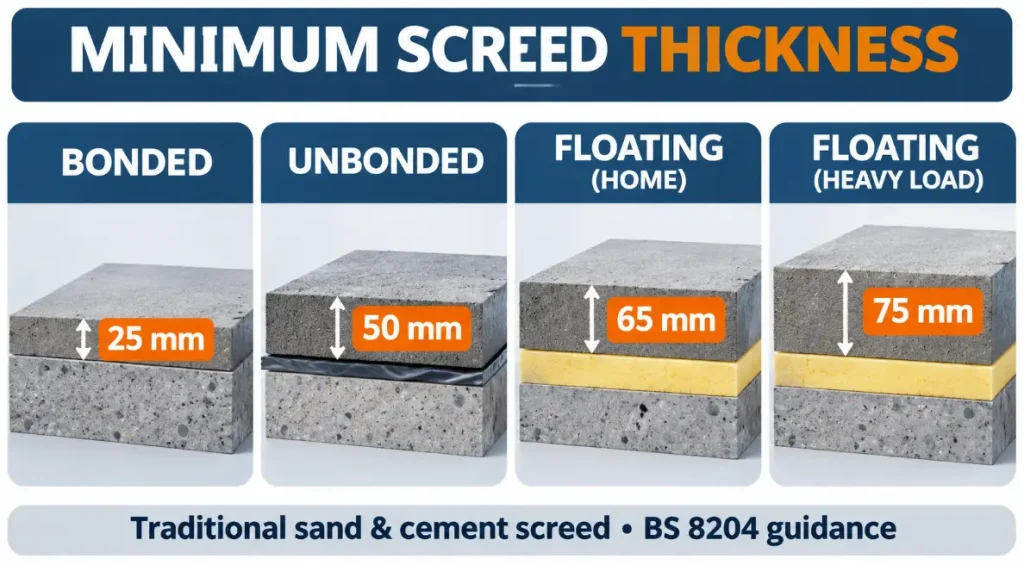
The minimum screed thickness depends on the type of floor and the material you use. For traditional sand and cement screed, bonded floors need at least 25 mm, unbonded floors need 50 mm, and floating floors need 65–75 mm. Underfloor heating also needs enough space to cover the heating pipes.
Choosing the right floor screed thickness helps prevent cracks and uneven floors. If the screed is too thin, it may break over time. If it is too thick, you spend more on materials and wait longer for it to dry. This guide explains how to choose the right screed thickness for your project. For a broader introduction to the purpose and construction of screed layers, read our guide to what screed flooring is.
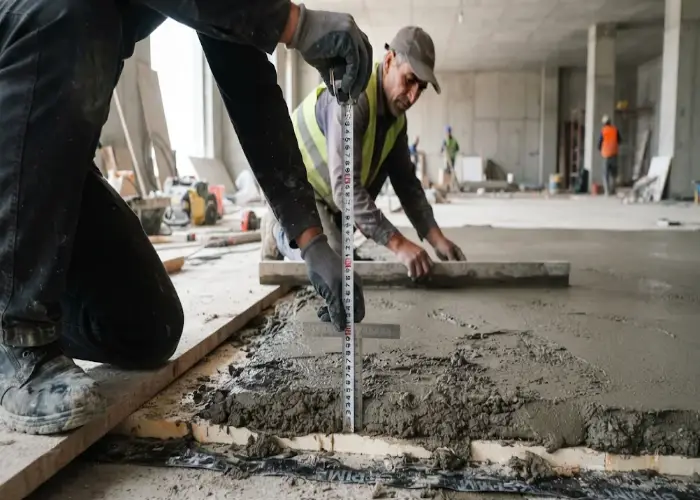
Minimum Screed Thickness by Floor Type
Here is the minimum screed thickness based on guidance associated with BS 8204-1 and the Concrete Society:
| Screed type | Minimum thickness | Typical design thickness |
| Bonded screed | 25 mm | 40 mm |
| Unbonded screed | 50 mm | 70 mm or more |
| Floating screed, domestic | 65 mm | 90 mm or more |
| Floating screed, heavier loads | 75 mm | 100 mm or more |
| Flowing screed | Product-dependent | Often 35–50 mm |
| Underfloor heating screed | System-dependent | Often 65–75 mm for traditional systems |
What Is Floor Screed Thickness?
Floor screed is a layer of cement-based or other suitable material that is placed over a concrete slab, insulation, or a separating membrane. It creates a level surface for tiles, timber, vinyl, carpet, and other floor finishes.
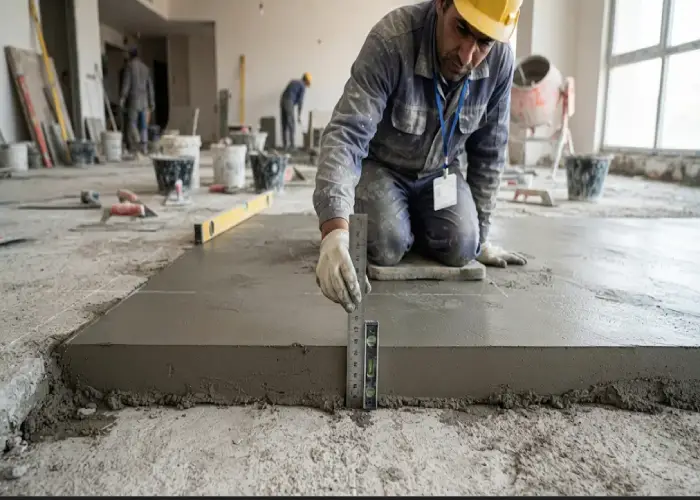
Screed thickness is measured vertically from the surface beneath the screed to its finished upper surface. For heated floors, the depth above the heating pipes is another important measurement. A thick screed is not automatically stronger. Its performance also depends on the material, bond quality, compaction, curing, and expected loads.
Bonded Screed Thickness
A bonded screed is applied directly to a prepared concrete base. Because it adheres to the slab, it can be thinner than other traditional screed systems. The minimum bonded screed thickness is 25 mm, although a 40 mm design thickness is commonly used to allow for variations in the concrete surface.
The concrete must be clean, sound, and properly prepared. Dust, oil, and loose material can weaken adhesion. Remember that increasing the depth without considering the bond can cause problems.
Unbonded Screed Thickness
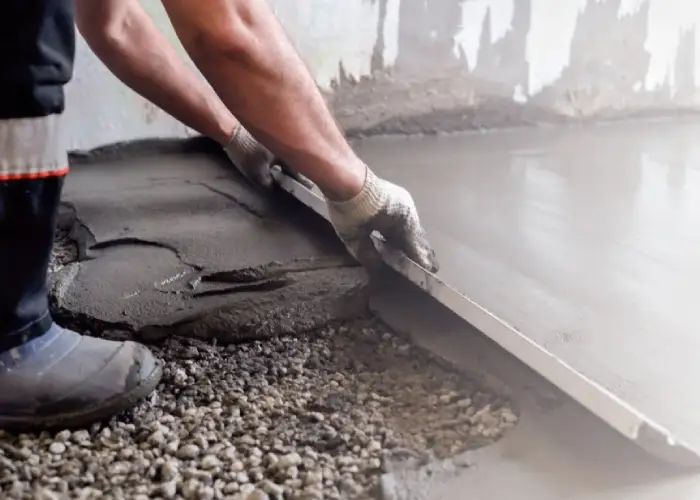
An unbonded screed sits on a plastic membrane instead of sticking to the concrete floor. Traditional screed needs at least 50 mm of thickness. For uneven floors, contractors often use around 70 mm or more for a thick screed. Make sure the membrane covers the floor properly. The screed also needs enough thickness to prevent cracks. Contractors use unbonded screed when they cannot bond the screed directly to concrete or when the floor needs protection from moisture. Comparing the different types of floor screed can also help you decide whether a bonded, unbonded, or floating system suits the subfloor.
Floating Screed Thickness
Floating screed sits on insulation that helps keep heat in and reduce noise. For homes, the minimum floating screed thickness is usually 65 mm. Floors that carry heavier loads need at least 75 mm. Choose strong insulation that can support the screed and the weight on the floor. If the insulation is too soft, the screed may crack. Also, leave enough space around the edges and add movement joints where needed to help prevent cracks. Movement joints, perimeter insulation strips, and the expected floor loads should all be considered during design.
Sand and Cement Screed Thickness
Traditional sand and cement screed are common in residential and commercial construction. It is normally mixed to a semi-dry consistency, placed, compacted, and levelled. The correct sand and cement screed thickness depends on its installation method:
- Bonded: minimum 25 mm
- Unbonded: minimum 50 mm
- Floating: generally 65–75 mm minimum
A mix ratio of one part cement to three or four parts suitable sand is commonly used. Adding more cement does not automatically produce a better floor. Water content, aggregate grading, compaction, and curing all affect performance.
Screed Thickness for Underfloor Heating
Underfloor heating pipes need enough screed above them to spread heat evenly and prevent cracks. The screed thickness for underfloor heating depends on the material and pipe size. Flowing screed often needs 25–30 mm above the pipes, while traditional sand and cement screed usually needs a total depth of 65–75 mm. For example, a 16 mm pipe with 30 mm of screed above it needs at least 46 mm of space. However, the floor may need more.
How to Calculate Floor Screed Thickness and Material Quantity
Before ordering materials, measure the floor area and determine the required screed depth. The basic calculation is:
Screed volume (m³) = Floor area (m²) × Screed thickness (m)
For a room measuring 50 m² with a 60 mm screed:
50 × 0.06 = 3 m³
The theoretical material requirement is 3 cubic metres. Measure the substrate at several points. The thinnest part of the completed screed must have the specified minimum floor screed depth.
What Happens if Screed Is Too Thin or Too Thick?
If the screed is too thin, it may crack or break under heavy furniture and foot traffic. This can also damage the flooring above it. A thick screed uses more materials, costs more, and takes longer to dry. It can also slow down underfloor heating. Choose the right thickness for your floor type and the weight it needs to support.

Choosing the Right Screeding Equipment in Tiran Tunnel Bistoon
For large projects, using the right equipment can save time and reduce manual work. Mortar pumps and sand-conveying machines help workers move materials around the site faster. The best machine depends on the screed mix, material type, and working distance. Need reliable equipment for your project? Visit Tiran Tunnel Bistoon to explore construction machinery or contact the team for help choosing the right machine. For moving compatible screed materials on larger sites, explore our material transfer equipment and compare its specifications with your project requirements.
FAQs
- What is the minimum screed thickness for a concrete floor?
The minimum screed thickness for traditional bonded screed is 25 mm. Contractors usually aim for 40 mm.
- Can screed be 20 mm thick?
Yes, some special screeds work at 20 mm. Regular sand and cement screed needs at least 25 mm when bonded to concrete.
- Is 50 mm screed thick enough?
Yes, 50 mm is enough for traditional unbonded screed. Floating screed thickness usually starts at 65 mm.
- What is the right screed thickness for underfloor heating?
The screed thickness for underfloor heating depends on the system. Flowing screed often needs at least 25 mm above the pipes.
- How can I save money on floor screeding?
Measure the floor carefully and avoid using more material than you need. For larger projects, contact Tiran Tunnel Bistoon to find suitable screeding and material-handling equipment.