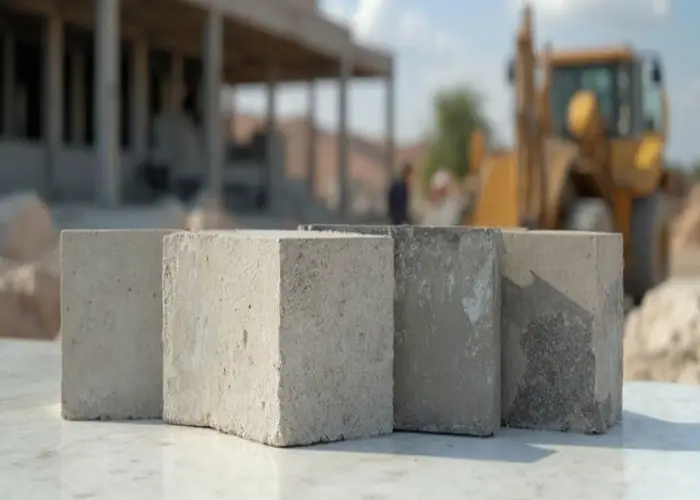
Concrete ratios and grades are the classification of concrete based on its 28-day compressive strength. The Code of Practice M-grade refers to a characteristic cube strength of 20 MPa. In the European C-class system, C20/25 indicates a cylinder strength of 20 MPa and a cube strength of 25 MPa. Lower grades are typically employed for levelling and non-structural applications, while medium and high grades are used for reinforced structures, heavier load applications, severe exposure conditions, and major infrastructure projects. Selecting the appropriate concrete grade and mix ratio is also important when using construction equipment such as a Mortar spraying machine, as material consistency and strength can directly affect application performance and final results.
What Are the Grades of Concrete?
Concrete strength grades are performance designations and not a recipe for concrete. Characteristic compressive strength is the strength value below which no more than 5% of valid test results are expected to fall. It is therefore a statistical characteristic value, not the average strength of five specimens. The strength is expressed in megapascals, and 1MPa is equivalent to 1N/mm².
Engineers use the grade to define concrete used to safely support the design load. But strength is not the only consideration in the decision. Even when loading on the concrete structure is moderate, a more resistant concrete mix can be necessary if it is exposed to water, sulfates, chlorides, freezing, abrasion or exposure to aggressive chemicals.
What’s the Difference between M Grades and C Grades?
There are two systems used when talking about different concrete grades:
In standards that have had a significant Indian influence, M grades such as M10, M20, M30 and M40 are commonly used. The number represents the 28 day 150 mm cube compressive strength. M30 is then a typical cube strength of 30 MPa.
Central Public Works Department (CPWD)C classes, including C20/25, C25/30, and C30/37, are used in EN 206 and Eurocode practice. The first number indicates the characteristic cylinder strength and the second number is the characteristic cube strength.
Thus, C30/37 indicates a cylinder strength of 30 MPa and a cube strength of 37 MPa. It is dangerous to regard M30 and C30/37 as synonymous since the specimens and classification systems are distinct.
Common Concrete Grades and Uses
This table provides a practical overview of different concrete grades and their typical applications.
| Grade | 28-Day Strength | Typical Uses |
| M5–M7.5 | 5–7.5 MPa | Blinding, bedding, void filling, and temporary non-structural work |
| M10 | 10 MPa | Levelling concrete, kerbs, pathways, and non-load-bearing work |
| M15 | 15 MPa | Plain concrete floors, non-reinforced bases, bedding and general PCC work where permitted |
| M20 | 20 MPa | Minimum grade commonly permitted for reinforced concrete under mild exposure in Indian practice, subject to structural design and local specifications. |
| M25 | 25 MPa | Reinforced foundations, slabs, beams, columns, and structural work |
| M30–M35 | 30–35 MPa | Heavier buildings, retaining structures, industrial floors, and infrastructure |
| M40–M55 | 40–55 MPa | Bridges, high-rise members, precast units, and demanding foundations |
| M60+ | 60 MPa or more | High-strength columns, long spans, specialised precast work, and major infrastructure |
better to read: Different Types of Floor Screed
Concrete Mix Ratios and Grades
A traditional concrete mix ratios and grades is written as:
Cement : Fine Aggregate : Coarse Aggregate
For example, a 1:2:4 mix contains one part cement, two parts sand, and four parts coarse aggregate. These proportions are often measured by volume for small nominal mixes, although controlled construction should use accurate batching by mass.
| Nominal Grade | Approximate Volumetric Ratios for General Reference |
| M5 | 1:5:10 |
| M7.5 | 1:4:8 |
| M10 | 1:3:6 |
| M15 | 1:2:4 |
| M20 | 1:1.5:3 |
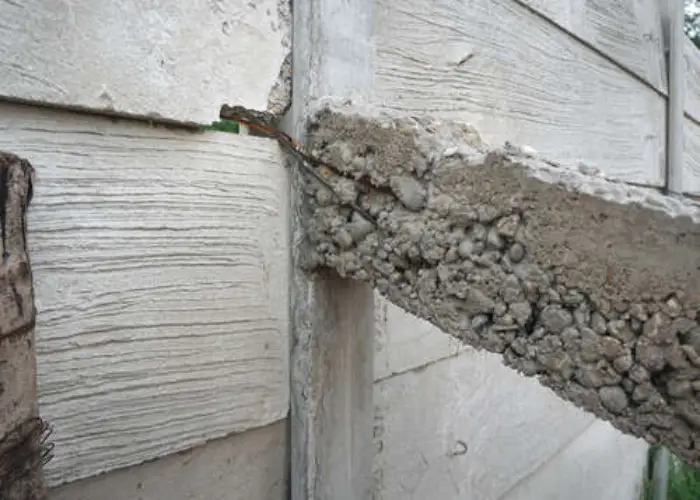
These familiar concrete ratios and grades are useful for understanding basic proportioning, but they do not guarantee the stated strength. Aggregate grading, particle shape, moisture, cement performance, water content, compaction, curing, admixtures, and quality control can all change the final result.
For M25 and higher concrete strength grades, a laboratory-designed mix should normally replace a fixed site ratio. The producer measures materials by mass, prepares trial batches, checks workability and strength, and adjusts the proportions to satisfy structural and durability requirements.
Why the Water–Cement Ratio Matters
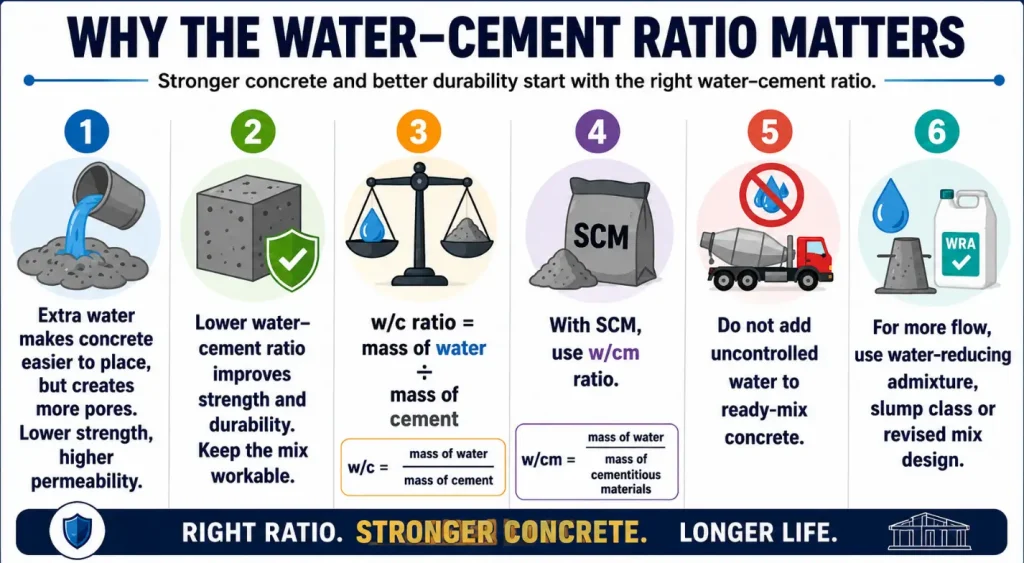
The water–cement ratio has a major effect on concrete strength and durability.
- Extra water makes fresh concrete easier to place, but it also creates more pores after hardening. More pores usually mean lower strength and higher water permeability.
- A lower water–cement ratio can improve strength and durability, provided the mix remains workable and can be compacted properly.
- The w/c ratio compares the mass of water with the mass of cement.
- When supplementary cementitious materials are used, the w/cm ratio may be specified instead.
- Do not add uncontrolled water to ready-mix concrete on site.
- When more flow is needed, use an approved water-reducing admixture, slump class or revised mix design.
What Controls the Final Concrete Strength?
The selected concrete ratios and grades will only be achieved when the concrete is produced and handled correctly. Important factors include:
- Accurate batching of cement, aggregates, water, and admixtures
- Suitable aggregate grading and maximum aggregate size
- Controlled water-to-cementitious-material ratio
- Proper mixing and transportation
- Adequate compaction without under-vibration, over-vibration or segregation.Protection against rapid moisture loss
- Correct curing temperature and duration
- Cube or cylinder testing under recognised procedures
Concrete continues to gain strength as cement hydration progresses. Although 28 days is the standard reference age for most acceptance testing, some mixtures containing supplementary cementitious materials may be specified at 56 or 90 days because their strength develops more slowly.
How to Choose the Right Concrete Grade
Concrete types and grades depend on the structure, exposure conditions and construction method.
- Lower grades may be suitable for pathways, blinding and plain concrete.
- Higher grades are often needed for columns, bridges, industrial floors and heavy foundations.
- Marine salts, sulfates, groundwater, freezing and chemicals may require more durable concrete.
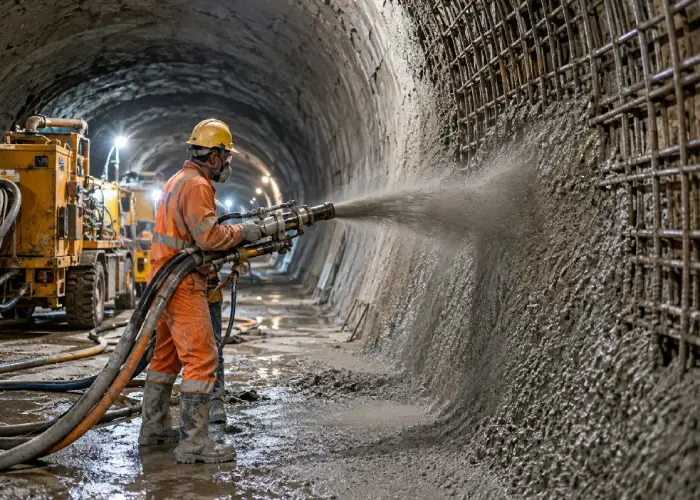
- Pumped concrete, shotcrete and congested reinforcement need suitable workability and aggregate size.
- Accurate batching, mixing, compaction and curing are essential for achieving the specified strength.
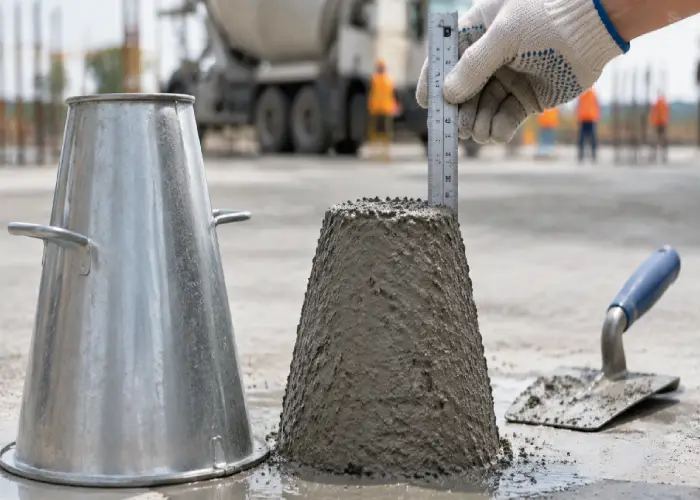
- Slump tests and cube or cylinder tests confirm whether the delivered concrete meets the project requirements.
better to read: What is Shotcrete
Concrete is usually tested at 28 days. Some mixes containing supplementary cementitious materials may also be tested at 56 or 90 days.
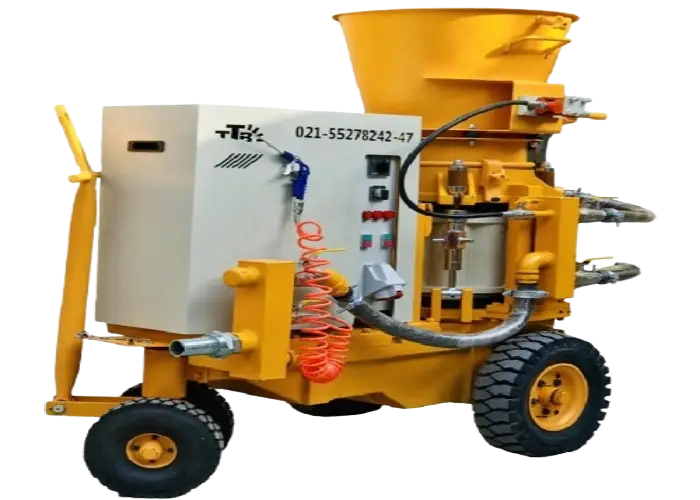
Tiran Tunnel Bistoon and Concrete Equipment
Selecting different types of concrete grades must be supported by suitable mixing, conveying, spraying, and finishing equipment. Tiran Tunnel Bistoon designs and supplies machinery for concrete and mortar operations, including shotcrete machines, piston spraying units, mortar sprayers, and screed systems. Its equipment is used in applications such as tunnelling, underground construction, surface spraying, and floor preparation. Matching equipment output, operating pressure, and aggregate capacity to the approved concrete mix can improve placement consistency. Visit our website and choose the best machine.
FAQs
- What does M20 concrete mean?
M20 is concrete specified to achieve a characteristic compressive strength of 20 MPa on a standard 150 mm cube at 28 days. - Is a 1:2:4 concrete mix equal to M15?
A 1:2:4 ratio is traditionally associated with nominal M15 concrete. However, actual strength still depends on material quality, water content, batching accuracy, compaction, and curing. - Which concrete grade is best for a house?
M20 or M25 is commonly specified for many residential reinforced-concrete elements. The final choice depends on soil conditions, spans, building height, seismic design, exposure, and local structural codes. - Are concrete grade and concrete type the same?
No. Grade mainly describes compressive strength. Type describes the material or construction method, such as reinforced concrete, self-compacting concrete, fibre-reinforced concrete, lightweight concrete, or shotcrete.