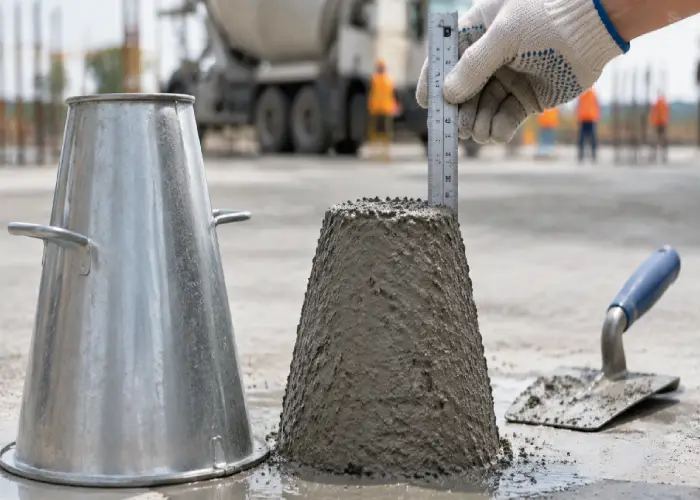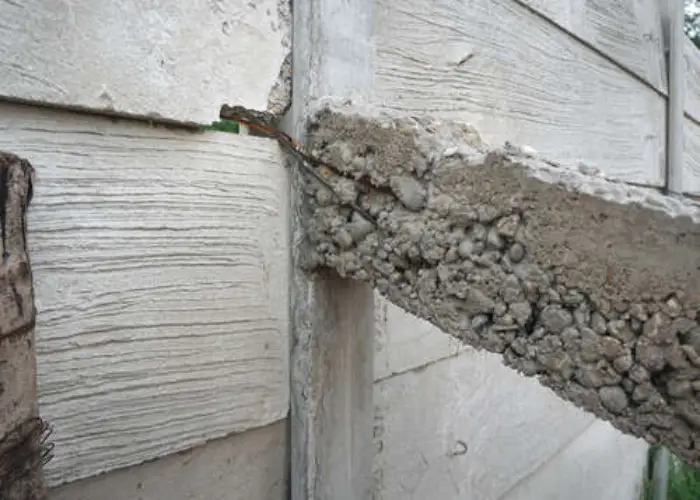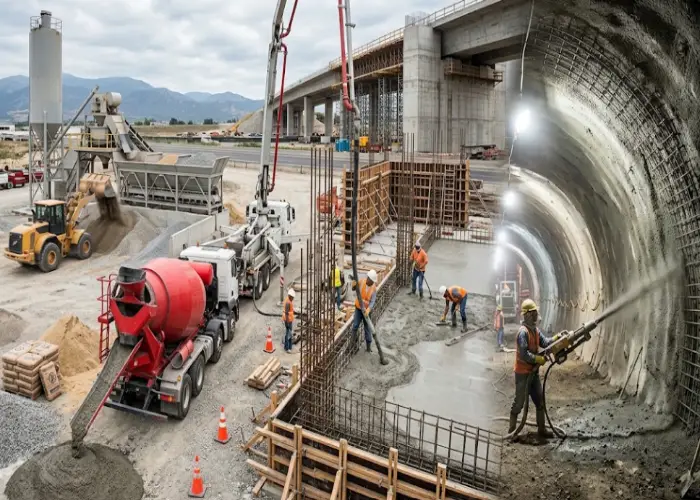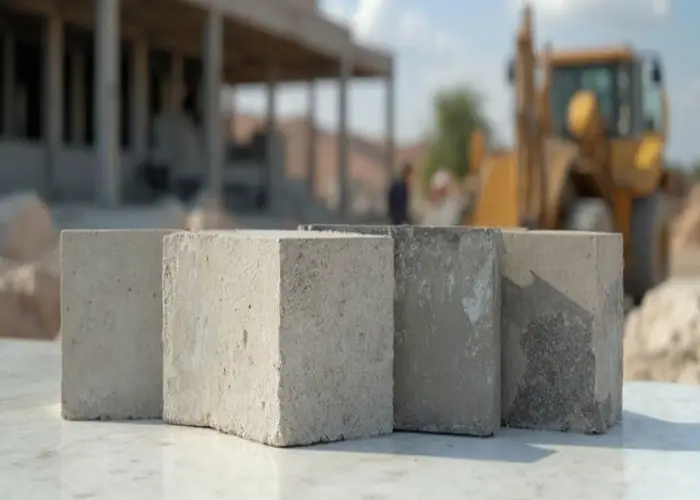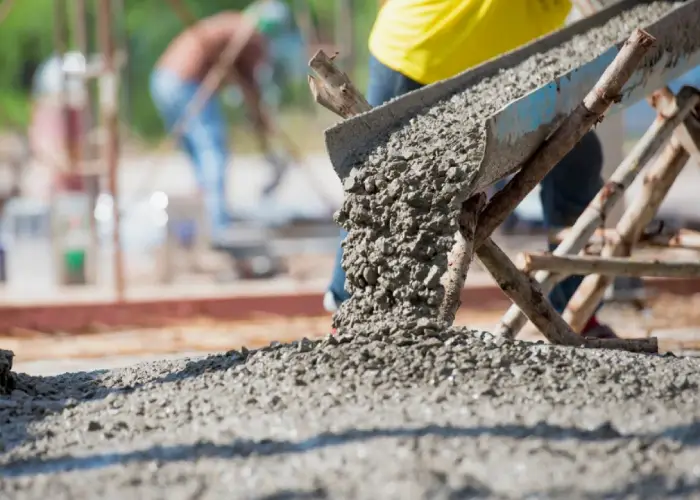
The Cement, Sand and Coarse Aggregate ratio in a concrete mix is termed the Concrete material ratio. An example of this is the material that is used for building a wall, which is one part cement, two parts sand, and four parts coarse aggregate. However, achieving a uniform concrete mix also depends on the proper handling and transportation of raw materials. In large construction projects, using a Material transfer device can help move cement, sand, and aggregates efficiently while maintaining the required mix quality. But there is no one ratio that is appropriate for all projects. The right combination of them is determined by the kind of strength needed, type of structure, material, weather conditions, and quantity of water to be used. Continue reading to find out more about standard concrete mix ratio.
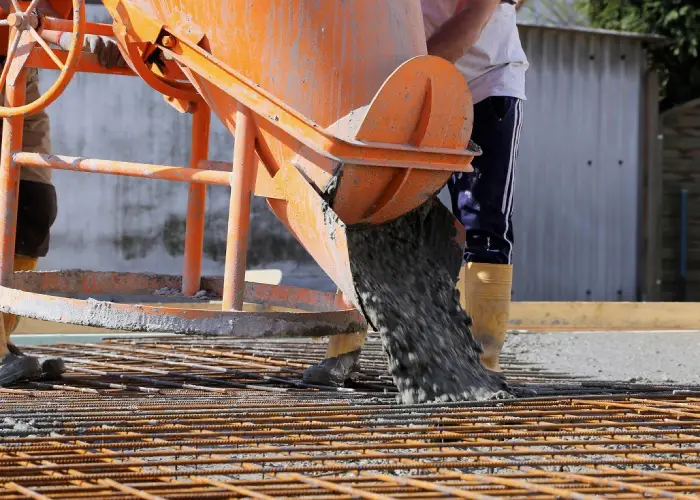
What Is a Concrete Material Ratio?
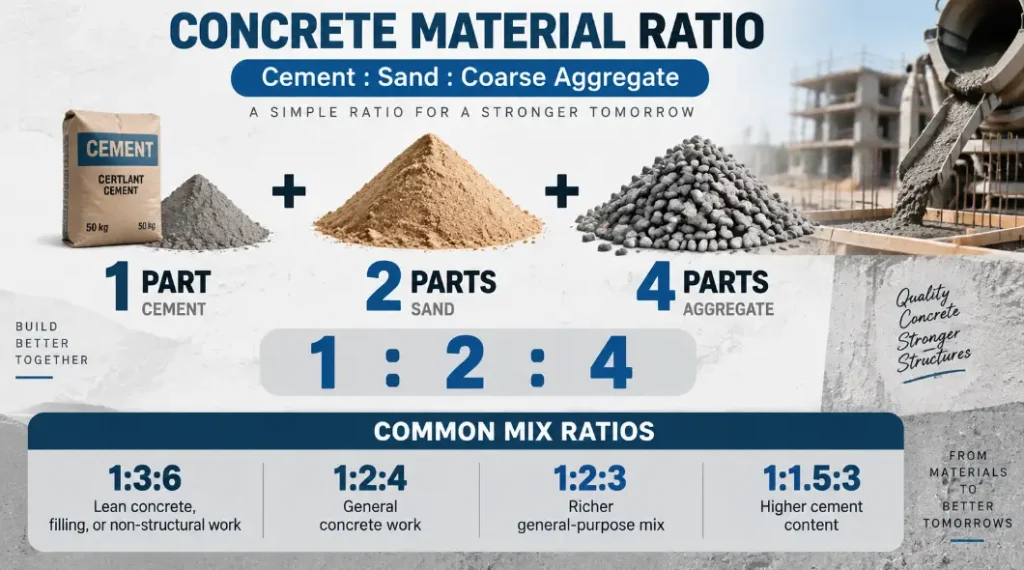
A concrete material ratio simply shows how much cement, sand, and aggregate are used compared with each other. It is often written as:
Cement: Sand: Coarse Aggregate
For example, a ratio of 1:2:4 means:
- 1 part cement
- 2 parts sand
- 4 parts coarse aggregate
If one bucket is used as the measuring unit, the mix would contain one bucket of cement, two buckets of sand, and four buckets of aggregate.
better to read: Types of concrete
Standard Concrete Mix Ratio
There is no universal standard concrete mix ratio for every construction job. Ratios such as 1:3:6, 1:2:4, 1:2:3, and 1:1.5:3 are traditional nominal proportions that can be seen in general construction references, but they should not be treated as guaranteed strength grades.
| Concrete Mix Ratio | Typical Use |
| 1:3:6 | Lean concrete, filling, or non-structural work |
| 1:2:4 | General nominal concrete work |
| 1:2:3 | Richer general-purpose mix |
| 1:1.5:3 | Richer mix where a higher cement content is required |
When designing structures, engineers will typically choose the concrete in order to meet compressive strength, durability, workability, and exposure requirements rather than using a concrete ratio from a simple table.
The American Cement Association states that proper proportioning of all the ingredients is essential for good concrete, not just adding more cement.
Concrete Material Ratio for Slab
Standard concrete mix ratio for slab relies on the kind of slab that is to be constructed. A simple concrete area or small non-structural floor can be treated with a simple nominal mix.
There is no single ratio, like 1:2:4 that can be safely recommended for every slab. Several factors need to be taken into consideration, such as:
- Load on the slab
- Slab thickness
- Reinforcement
- Concrete strength
- Ground or support conditions
- Weather exposure
- Moisture conditions
- Required service life
For an engineered slab, the specified concrete strength and mix design should take priority over a general cement-sand-aggregate ratio.
Cement, Sand, and Aggregate Proportions
Many materials included in a concrete mix have different functions in a standard concrete mix ratio:
Cement
The binder is cement. Once added to water, the hydration process starts, and a paste envelops the aggregates.
Strength, workability, heat generation, shrinkage, and cost may be influenced by the amount of cement used. An increase in cement does not necessarily guarantee good quality of concrete.
Sand
It occupies voids created by the larger aggregate particles and assists in making a workable, compact mix. The sand must be clean and suitable for the making of concrete.
Coarse Aggregate
The coarse aggregate is usually composed of gravel or crushed stone. It contributes to the concrete volume and gives strength, stiffness, and dimensional stability.
The size, shape, grading, strength, and durability of the aggregate affect the performance of the concrete. In addition, FHWA guidance identifies the properties of coarse aggregate as a critical factor in the strength and other properties of concrete.
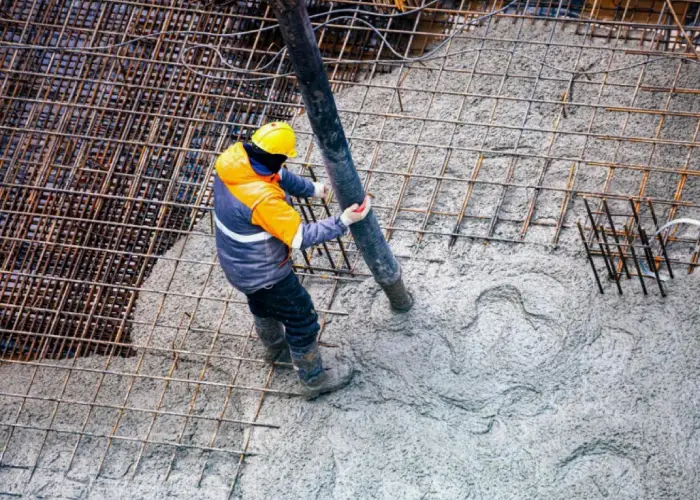
The basic concrete material ratio formula is:
Cement: Sand: Coarse Aggregate
For a 1:2:4 mix:
- Cement = 1 part
- Sand = 2 parts
- Coarse aggregate = 4 parts
The total is:
1 + 2 + 4 = 7 parts
So, in simple volume terms:
- Cement = 1/7 of the dry proportion
- Sand = 2/7
- Aggregate = 4/7
This is useful for basic estimating, but it is not a complete concrete mix design formula. Water, moisture in the aggregates, admixtures, air content, material density, and required concrete properties also need to be considered on professional projects.
Why the Water-Cement Ratio Matters
The water-cementitious material ratio is the ratio of the mass of mixing water to the mass of cementitious material. ACI defines it on a mass basis, rather than by volume.
Excessive amounts of water will make fresh concrete easier to work with, but it can reduce strength and increase permeability after the concrete has hardened.
Generally, a lower w/c ratio and workable concrete lead to higher strength and durability.
Common Concrete Mix Problems
The following are common problems that occur with concrete material ratio:
- Adding additional water at the jobsite because it seems difficult to place the concrete. This can temporarily make the concrete easier to work, but it can adversely affect the hardened concrete quality.
- Another issue is applying the same concrete mix ratio to all work. The requirements for a garden path and structural slab, foundation, industrial floor, or tunnel lining are different.
- The quality of the aggregate may not satisfy the required specifications, even though the quantities of cement and sand are appropriate.
- Poor curing is another common problem. During the development of its strength, concrete must have an appropriate moisture and temperature regime. A good mix will fail to perform well if installed, compacted, finished, and cured incorrectly.
How to Choose the Right Concrete Material Ratio
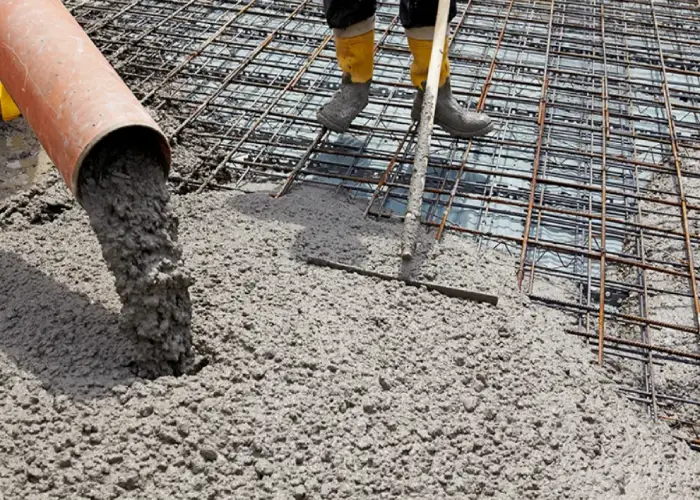
To choose the best concrete material ratio in structural or demanding construction, it is better to begin by specifying the desired performance of the concrete. The engineer can then work out what the cementitious content is, what proportions of aggregates are needed, the water-cementitious ratio required, what admixtures are required, and so on, to satisfy that requirement.
The ideal concrete mix would be:
- Workable enough to place
- Strong enough for its intended load
- Durable in its environment
- Economical to produce
- Suitable for proper compaction and finishing
Concrete Mixing and Tiran Tunnel Bistoon (TTB)
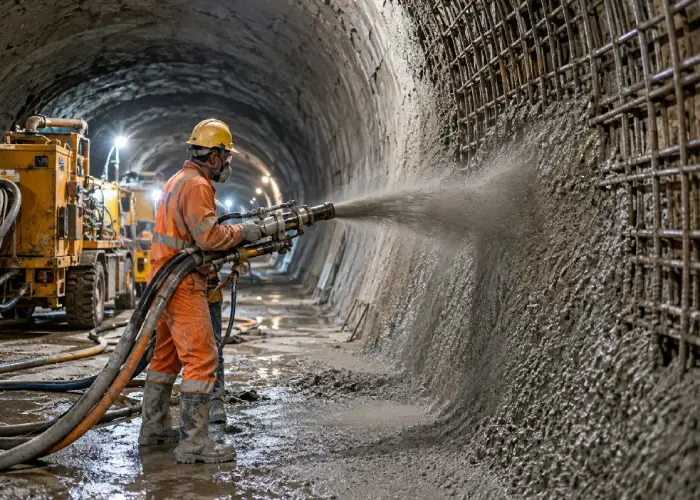
With underground construction and shotcrete applications, standard concrete mix ratio of materials is more critical, as equipment, material consistency, placement, and site conditions impact the end product. Tiran Tunnel Biston (TTB) produces construction equipment such as wet shotcrete machines, dry shotcrete machines, cement-mortar spraying pumps, material conveying systems, and mortar pumps. Working with the right concrete or mortar mix and proper equipment to increases the consistency of placement and enhances the performance of the concrete or mortar in tunnel, mining, repair, and other construction applications. Visit our website and choose the best equipment.
FAQ
- What is the standard concrete material ratio?
There is no single standard ratio for all concrete. 1:2:4 is a well-known nominal proportion, but structural concrete should be selected according to the required strength, durability, and project specification.
- What does a 1:2:4 concrete ratio mean?
It means one part cement, two parts sand, and four parts coarse aggregate.
- What is the Standard concrete mix ratio for slab?
It depends on the slab design. Small non-structural work may use a nominal mix, while reinforced structural slabs normally require concrete designed to meet a specified strength and durability level.
- Does more cement always make concrete stronger?
No. Strength also depends on water content, aggregate properties, compaction, curing, and the overall mix design.
- Why is the water-cement ratio important?
It has a strong effect on concrete strength, permeability, and durability. Too much water generally reduces the quality of hardened concrete.